地址:昆明市五华区(点击查看地图)
场馆:昆明市五华区



第八届国际新型光电探测技术及其应用研讨会
2021-12-11~2021-12-1291620昆明
 活动说明
活动说明Sponsors:
Chinese Society for Optical Engineering (CSOE)
Organizers:
Photoelectronic Technology Committee, Chinese Society of Astronautics
Chairs:
SU Junhong (Kunming Institute of Physics)
CHEN Lianghui (Institute of Semiconductors, CAS)
CHU Junhao (The Shanghai Institute of Technical Physics of the Chinese Academy of Sciences)
ZHU Shining (Nanjing University )
ZHU Shining (Nanjing University )
YU Qifeng (National University of Defense Technology)
 组织机构
组织机构Sponsors:
Chinese Society for Optical Engineering (CSOE)
Organizers:
Photoelectronic Technology Committee, Chinese Society of Astronautics
Chairs:
SU Junhong (Kunming Institute of Physics)
CHU Junhao (The Shanghai Institute of Technical Physics of the Chinese Academy of Sciences)
YU Qifeng (National University of Defense Technology)
 专家报告
专家报告 投稿指南
投稿指南Submission
Conference Website:
Abstract Submission link: https://b2b.csoe.org.cn/submission/NDTA2021.html
Abstract Deadline: 30 Nov. 2021
Abstract Deadline: 30 Nov. 2021
SPIE Website:
SPIE Manuscript submission link: https://spie.org/submissions/submit/overview.aspx?EventId=2603225
SPIE Manuscript Deadline: 20 Dec. 2021
投稿说明:
英文稿件需先在会议网站提交摘要,摘要审稿通过后,再去SPIE网站提交全文;
中文稿件需在会议网站直接提交全文。
请务必在收到组委会的SPIE文集录用通知后,再到SPIE网站提交稿件全文,如未收到录用通知,请不要去SPIE网站提交稿件全文。
英文稿件摘要模板:
English Abstract Template:
Abstract Template.doc
英文稿件全文模板:
English Manuscript Template:
SPIE Manuscript Specifications_4 to 6 page papers.doc
中文稿件模板:
Template.pdf
备注:
SPIE全文投稿网站由SPIE的编辑创建并负责管理,如提交全文过程中遇到任何问题,请与以下SPIE编辑联系:
投稿说明:
英文稿件需先在会议网站提交摘要,摘要审稿通过后,再去SPIE网站提交全文;
中文稿件需在会议网站直接提交全文。
请务必在收到组委会的SPIE文集录用通知后,再到SPIE网站提交稿件全文,如未收到录用通知,请不要去SPIE网站提交稿件全文。
English Abstract Template:
Abstract Template.doc
英文稿件全文模板:
English Manuscript Template:
SPIE Manuscript Specifications_4 to 6 page papers.doc
中文稿件模板:
Template.pdf
备注:
SPIE全文投稿网站由SPIE的编辑创建并负责管理,如提交全文过程中遇到任何问题,请与以下SPIE编辑联系:
Jenny Woods
Manager, Proceedings
SPIE – the international society for optics and photonics
jennyw@spie.org
Tel: +1 360 685 5482
Fax: +1 360 647 1445
Ms. Toni Bistodeau
Conference Proceedings Coordinator
SPIE
tonib@spie.org
论文出版SPIE Proceeding (EI)
The white paper on the value of proceedings is at The unique value of Proceedings of SPIE  Value of Proceedings.pdf
Value of Proceedings.pdfPresenting and publishing your research in Proceedings of SPIE has multiple professional and business benefits. Read The Value of Proceedings white paper for a comprehensive discussion.
Proceedings of SPIE are uniquely valuable as they are used by researchers worldwide, and lead in patent cites among optics and photonics collections. They frequently rank among the 50 most used serials, out of 50,000 analyzed by Ex Libris. If it is ready for journal publication, your proceedings paper can be submitted with minimal or no revision for consideration in the relevant SPIE journal.
Indexed and accessible
SPIE partners with relevant scientific databases to enable researchers to find Proceedings of SPIE. They are indexed in Web of Science, Scopus, Ei Compendex, Inspec, Google Scholar, Astrophysical Data System (ADS), CrossRef, and other scholarly indexes, and are widely accessible to leading research organizations, conference attendees, and individual researchers.
Supported Journals:
Journal of Infrared and Millimeter Waves (SCI, EI)
Infrared and Laser Engineering (Ei)
Optics and Precision Engineering (Ei)
Chinese Optics (Ei)
Acta Armamentarii (EI)
ACTA PHOTonICA SINICA (EI)
Acta Aeronautica et Astronautica Sinica (EI)
Electronics Optics & Control
Journal of Terahertz Science and Electronic Information Technology
Information and Control
Infrared Technology
Modern Defense Technology
Optics & Optoelectronic Technology
RADIO ENGINEERING
RADIO ENGINEERING
SPIE Journals
SPIE publishes ten significant journals in major areas of optics, photonics, and imaging.
These journals welcome submission of journal-ready manuscripts that are derived from conference papers, as appropriate for each journal.
See the SPIE policy on submission of manuscripts derived from conference papers.
Conference Proceedings Papers
Submissions to SPIE journals based on reports that have been submitted to or published in a conference proceedings should adhere to the following guidelines:
Distinction between proceedings and journal papers:
Conference proceedings provide a vehicle for rapid reporting of ideas, techniques, and results. It is not uncommon for these reports to be somewhat incomplete and inconclusive. The purposes of proceedings papers range from snapshots of recent or continuing work to the reporting of a completed work or project. Journal papers are expected to be original, complete, and polished; to contain comparisons of theoretical and experimental results; and to include substantial conclusions and comprehensive references to other work.
Revision of conference proceedings manuscripts for journal submission:
SPIE publication policy permits manuscripts based partly or entirely on scientific content previously reported in SPIE proceedings to be submitted to SPIE journals. Furthermore, SPIE permits manuscripts based partly or entirely on scientific content previously reported in a non-SPIE conference to be submitted to SPIE journals so long as the copyright policies of the non-SPIE conference are properly adhered to (see below). In most cases, it is anticipated that the journal submission will represent a substantively expanded, refined, or otherwise revised manuscript relative to the proceedings paper to fully satisfy the standards of significance, originality, and presentation quality expected in a journal submission that is being considered for acceptance through the journal peer-review process. A manuscript submitted to an SPIE journal that incorporates minimal or no revisions over a prior or concurrent SPIE proceedings paper may be considered for publication in an SPIE journal and admitted into the peer-review process provided the submission fulfills the requirements of significance, originality, and completeness expected in a journal submission. SPIE does not consider publication of an accepted journal article based on a prior proceedings paper to constitute double publication.
Disclosure:
If a manuscript (or portion of a manuscript) was previously published in a conference proceedings or is under consideration for publication in a conference proceedings, this information must be disclosed when the manuscript is initially submitted to an SPIE journal. Authors should also reference or acknowledge the prior proceedings paper within the submitted journal article.
Copyright:
SPIE copyright policy permits authors to submit derivations of their proceedings papers to their journal of choice. Submissions to SPIE journals are permissible provided the other expectations described herein are satisfied. Authors submitting to journals published by other publishers should verify that publisher's copyright and submission policies. Authors wishing to submit papers that were presented at or published in a conference proceedings sponsored by organizations other than SPIE are responsible for adhering to the copyright policies related to that presentation or publication and are expected to disclose the prior presentation or publication history of the submission.
Journal submission format:
All proceedings manuscripts submitted to an SPIE journal must be prepared according to the guidelines provided here.
See more information at:
https://spie.org/publications/spie-journals
 会议日程
会议日程大会开幕式和大会报告:
1. 介绍与会嘉宾
2. 领导致辞
大会报告:
大会报告:
09:00-09:30,光学微结构及其在量子信息中的应用, 祝世宁,南京大学
09:30-10:00,面向高时空和高动态场景的多孔径成像系统,于起峰,国防科技大学
10:00-10:30,Challenges in Small Pitch InGaAs based SWIR Sensor, Yang NI, Tangram Image Sensor, France
10:30-11:00,Functional Biomedical Imaging with Multi-tap CMOS Pixels, Keiichiro KAGAWA, Shizuoka University
 会议注册
会议注册Registration information:
Participants must register for the conference at the following website:
Website: https://b2b.csoe.org.cn/registration/NDTA2021.html
Registration fee:
2808 RMB (After 10 Sep. 2021)
2608 RMB (Before 10 Sep. 2021)
Payment:
1. Remittance transfer:
会议注册信息:
Participants must register for the conference at the following website:
Website: https://b2b.csoe.org.cn/registration/NDTA2021.html
Registration fee:
2808 RMB (After 10 Sep. 2021)
2608 RMB (Before 10 Sep. 2021)
Conference registration fees include tickets for plenary talks , invited talks and exhibition, lunch, dinners, coffee breaks, conference manual, conference disk, etc., excluding paper layout fees and accommodation fees.
Payment:
1. Remittance transfer:
Bank of account: ICBC Beijing Science and Technology Park Branch
Account Name: Chinese Society for Optical Engineering
Account number: 0200296409200177730
2. online payment:
After registration, you can jump to the online payment page and select "Alipay" to complete the payment online.
2. online payment:
After registration, you can jump to the online payment page and select "Alipay" to complete the payment online.
When remittance, the author must indicate "NDTA + Cellphone number" for verification.
The meeting will provide a formal meeting fee invoice.
会议注册信息:
无论有无投稿,均欢迎注册参会!
参会者请务必到以下网址进行会议注册:
会议费:
2808元/人,2021年9月10日前汇款优惠为2608元/人。
会议费包括:
1、大会报告、分会报告、张贴报告和展区入场;
2、午餐、晚餐、会议期间茶歇;
3、会议手册、会议文集光盘、资料袋。
请注意:
1. 会议费不含论文出版费,中文稿件出版费由期刊收取,英文稿件出版费由SPIE收取。
2. 会议费不含住宿费,住宿费由酒店收取。
付款方式:
1. 银行汇款:
学会账号:0200296409200177730
开户银行:工行北京科技园支行
户 名:中国光学工程学会
2.在线支付:
注册完成后,可跳转到在线支付页面,选择“支付宝”在线完成支付。
请注意:
1. 汇款时请务必在附言中备注“NDTA+手机号”,以便核对。
2. 会议将提供正规会议费发票(优选电子发票,电子发票定向发送至注册人电子邮箱,纸质发票在会议现场发放)。
3. 建议开具普通发票,不建议开具专用发票,专票开票周期较长。
3. 建议开具普通发票,不建议开具专用发票,专票开票周期较长。
会员申请 企业赞助
企业赞助 下载文件
下载文件
Poster模板
 NDTA2021 Poster Template-80cmx80cm.pptx
NDTA2021 Poster Template-80cmx80cm.pptx海报尺寸:80cm*80cm
海报要求:内容中英文均可,需打印成彩色,请严格按照海报要求准备并自行打印带到会场。海报需包括稿件编号、论文题目、作者和单位,论文内容需包括引言,主要研究方法,实验数据和结果,可以配图。
 同期活动
同期活动
同期活动:
1. 光电技术和产品展会
1. 光电技术和产品展会
2. 红外光电探测产业研究专题报告会暨产业发展论坛
Workshop 交通住宿酒店名称:
昆明云安会都酒店
昆明云安会都酒店
酒店总机:
0871-68171666
酒店地址:
昆明市西山区石安公路马街路口云安会都酒店
住宿费:
会议统一安排在昆明云安会都酒店住宿,住宿费自理,住宿费交给酒店。
会议统一安排在昆明云安会都酒店住宿,住宿费自理,住宿费交给酒店。
会议协议价:
昆明云安会都酒店——清华池:350元/间天
预定酒店:
预定酒店:
请填写好以下酒店预订表,发送至邮箱:1525771301@qq.com,邮件中备注:参加光电探测会议,可以享受会议协议价。
 酒店预订-会议202110.xlsx
住宿问题请咨询酒店经理:周经理,15808895923
交通指南
酒店预订-会议202110.xlsx住宿问题请咨询酒店经理:周经理,15808895923
交通指南
从机场乘车
(一)乘出租车路线
1. 机场高速—南绕城高速—G56杭瑞高速—云安会都。全程约55公里。
2. 机场高速—北二环—西二环—G56杭瑞高速—云安会都。全程约41公里。
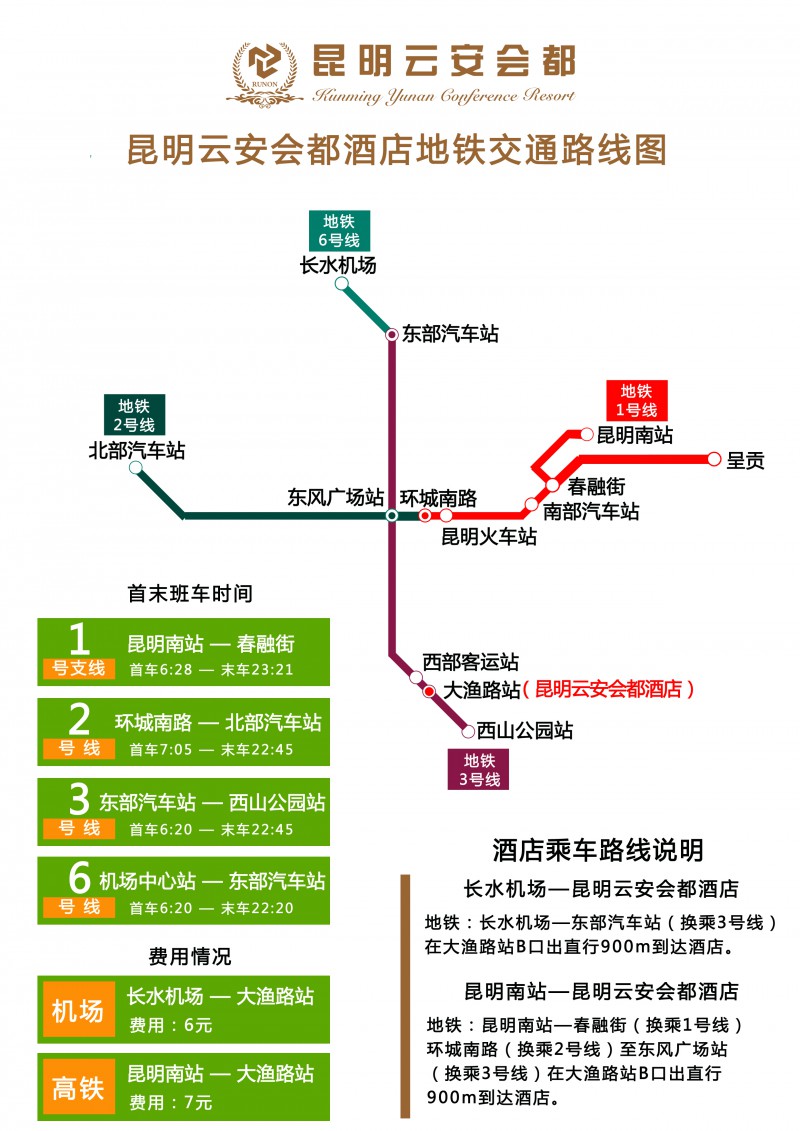
(二)乘地铁
长水机场地铁站,乘6号线,至东部汽车站下;换乘3号线,至大渔路站下,从 B 口出,步行900米到达云安会都。
(三)乘机场空港快线大巴转公交车
从长水机场乘空港快线1号线或2号 B 线大巴,再换乘公交汽车可达云安会都。
1. 空港快线1号线:长水机场上车,至西驿酒店(小西门原新南疆宾馆)下车;换乘100路公交车,至云安会都站下车。
2. 空港快线2号 B 线:长水机场上车,至泰丽国际酒店下车;
在民航路口换乘51路公交车,至云安会都站下车。
从昆明站乘车
(一)乘出租车
从昆明火车站乘出租车直达云安会都,距离约11公里,车程约20分钟。
(二)乘公交车
1. 从昆明火车站旁春城路站点,乘51路公交车,到云安会都站下,距离约11公里,车程约30分钟。
2. 步行至昆明站站前广场站,乘坐 Z33路公交车,在春城路站下;换乘51路,到云安会都站下。
3. 步行至昆明站站前广场站,乘坐80路公交车,在丹霞路口站下;换乘100路,到云安会都站下。
(三)乘地铁
步行至地铁环城南路站,乘2号线,至东风广场站下;换乘3号线,至大渔路站下,从 B 口出,步行900米到达云安会都。
从昆明南站乘车
(一)乘出租车
延昆磨高速9.8公里后,进入南绕城高速,车程约37分钟。
(二)乘地铁
步行至昆明南火车站地铁站,乘1号线支线,至春融街站下;换乘1号线,至环城南路站下;换乘2号线,至东风广场站下;换乘3号
线,至大渔路站下,从 B 口出,步行900米到达云安会都。
 联系方式
联系方式
Office:
Tel: 010-63726007
Tel: 010-63726007